Thursday, June 23, 2011

"Persepolis: The Story of a Childhood" by Marjane Satrapi


Image Courtesy of: http://www.randomhouse.com/pantheon/graphicnovels/art/persepolis_cover_big.jpg
Bibliographic Citation
Title: Persepolis: The Story of a Childhood
Author/Illustrator: Marjane Satrapi
Year of Publication: 2003
Publisher City: New York
Publisher: Pantheon
ISBN: 0375422307
Author/Illustrator Website: No Author/Illustrator Website
Media Used for Artwork: Ink

2009 Students’ List

Nonfiction Graphic Novel

My Top 10 Favorite Picturebooks for Older Readers

Awards
·         Fernando Buesa Peace Prize, 2003
·         New York Times Notable Book
·         Time Magazine “Best Comic of the Year,” 2003
·         Young Adult Library Services Association’s Alex Award, 2004

Annotation
This graphic novel tells the story of Marjane Satrapi as she grew up in Iran during the Islamic Revolution, a very turbulent time where her life was in constant change.

Personal Reaction
                What is happening in the Middle East is a huge concern for many people.  Yet in each country we are only given one side of the story.  The graphic novel autobiography from Marjane Satrapi provides another perspective that most American’s do not think about, someone from Iran.  Satrapi’s story attempts to show readers that not every person in Iran is an extremist, like the ones seen on the nightly news.  This is a good story to help keep people open-minded in a time when it is so easy to let biases and stereotypes dictate lives.
                The series of little vignettes is an interesting tool to deliver the story of the child’s life in the novel.  It works well because several different stories are told that interweave together, also it emulates a child’s mind that is always thinking of new things and topics.
                The illustrations are childlike as well, which also helps convey to readers that they are reading a story that is suppose to be from a child’s perspective.  Often times the figures and scenery are very simple, which puts emphasis on the words.  The use of black and white is very powerful, especially in moments where repetition of figures is used.  For example, in the section entitled “The Key,” the illustration of the girls beating their breasts is all the more powerful because it is in black and white.  There is no way to tell the girls apart, showing that they are all forced to deal with the circumstances of their lives.

Curriculum: Grade 10- According to California State Board of Education, students in 10th grade history are to learn about “the challenges in the regions, including their geopolitical, cultural, military, and economic significance and the international relationships in which they are involved.”  The Middle East is one of these locations. 
This graphic novel would be a good addition to this part of the curriculum because it teaches about the history of a region from the perspective of someone who lived through it.  All material is biased to some degree, but by providing multiple perspectives students are able to form a better understanding of controversial topics.

Use of Allusion: When the family goes on a vacation the family is seen on a flying carpet, reminiscent of “Arabian Nights.”

Use of Simile: The children often use similes in an attempt to understand the choices made my the government and adults.
“The revolution is like a bicycle.  When the wheels don’t turn, it falls.”

Use of Sophisticated Language: The narrator uses a variety of words that can be difficult to understand.  Many are military or political terms.
“The truth is that 50 years ago the father of the Shah, who was a soldier, organized a putsch to overthrow the emperor and install a republic.”

Tuesday, June 21, 2011

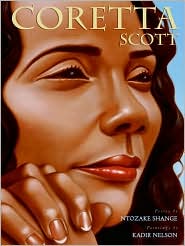
"Coretta Scott" by Ntozake Shange, Illustrated by Kadir Nelson

Image Courtesy of: http://img2.imagesbn.com/images/33250000/33257055.JPG
Bibliographic Citation
Title: Coretta Scott
Author: Ntozake Shange
Illustrator: Kadir Nelson
Year of Publication: 2009
Publisher City: New York
Publisher: Amistad
ISBN: 9780061253652
Illustrator Website: http://www.kadirnelson.com/
Media Used for Artwork: Oil paint

2009 Students’ List

Awards
·         School Library Journal Starred Review
·         Booklist Starred Review
·         Publishers Weekly Starred Review

Annotation
A biography picture book about Coretta Scott told through poetry.  But this story also tells the story of the Civil Rights Movement in which she was involved along with her husband Martin Luther King, Jr.

Personal Reaction
                A poem is used to convey part of Coretta Scott King’s life.  It is a unique way to tell a biography because facts can not be conveyed.  It is the emotions that Scott felt during her life that are felt.  Besides Scott’s life this picture book also conveys part of the Civil Rights Movement, such as the March on Washington.
                Nelson’s oil paintings are very detailed and add visuals to the poem by Shange.  This can aid readers in understanding what is being conveyed in the stanzas.  The detail in the eyes of characters makes it almost seem like a reader is looking at a picture.  There is a moment where Scott and her siblings are left by the white school bus and the reader can see the tears from the illustration.
                During Black History month, this book would be good as an introduction to the Civil Rights Movement.  Readers can understand the emotions that were behind people’s action in that time.  Then from there historical facts can be added for education.

Use of a Simile: Comparing the moon in a creative way beings the poem.
“some southern mornings
the moon
sits like an orange
sliver by the treetops”

Use of Repetition: In the illustrations repetition is seen a few times.  For example, the moon rising over blackened foliage is seen as are profiles of Scott and King where they were singing and praying.

"Rapunzel's Revenge" by Shannon and Dean Hale, Illustrated by Nathan Hale

Image Courtesy of: http://images.amazon.com/images/P/1599902885.01.LZZZZZZZ.jpg
Bibliographic Citation
Title: Rapunzel’s Revenge
Author: Shannon and Dean Hale
Illustrator: Nathan Hale
Year of Publication: 2008
Publisher City: New York
Publisher: Bloomsbury
ISBN: 9781599900704
Media Used for Artwork: Pencil, Ink

2009 Students' List

Fiction Graphic Novel

Awards
·         American Library Association’s Notable Children’s Book, 2009
·         Young Adult Library Services Association’s Great Graphic Novel for Teens, 2009
·         Eisner Award Nominee
·         Pacific Northwest Library Association’s Young Readers Choice Award, 2011

Annotation
A reinvention of the fairy tale of Rapunzel set as a western, with lassos and gun fights.  Rapunzel is not some damsel that must be rescued and sets out on her own journey of revenge.

Personal Reaction
                In literature and movies now reinterpreting classic stories is very popular, the reboot rules over all.  “Rapunzel’s Revenge” is one such graphic novel that takes a classic tale and modernizes it to keep readers interested.  Female readers will appreciate Rapunzel for her ability to think quickly and do things on her own.  Though Rapunzel is still locked in a tower, it is not because she is a damsel in distress, it is because she is strong willed and wouldn’t cave to pressure.  She doesn’t need to be saved by some prince, Rapunzel rescues herself.  The authors and illustrator take a few opportunities to make fun of the “classic” storylines of fairytales.  For example, while she is trapped in the tower, Rapunzel only has three books to read, and one is entitled “Girls who get saved and the Princes who save them.” 
Besides the powerful leading lady, the setting has changed as well.  The Hale’s (writers and illustrator) have set the fairytale in a Western, full of gunfights, horses, and lassos.  Changing the setting adds a great deal of tension; there is always another fight on the horizon.  Hale (the illustrator) took the Hales’ (the authors) ideas and created a world for the characters to run around in.  Because of the use of the graphic novel format there are panels were no words are spoken, yet a reader is still able to understand the action that is occurring.
This is definitely a fun read for older readers interested in fairytales and how they are being changed in the modern world.

Use of Alliteration:  Mother Gothel’s spells use alliteration.
Example:
“Grew Grow Growl Grot
Spin Spell Spool Spot
Flower Flutter Flicker Fly”

Monday, June 20, 2011

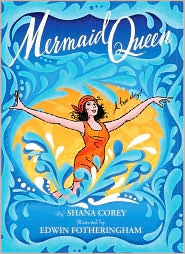
"Mermaid Queen: The Spectacular True Story Of Annette Kellerman, Who Swam Her Way To Fame, Fortune & Swimsuit History," by Shana Corey, Illustrated by Edwin Fotheringham

Image Courtesy of: http://img2.imagesbn.com/images/33600000/33604755.JPG
Bibliographic Citation
Title: Mermaid Queen: The Spectacular True Story Of Annette Kellerman, Who Swam Her Way To Fame, Fortune & Swimsuit History!
Author: Shana Corey
Illustrator: Edwin Fotheringham
Year of Publication: 2009
Publisher City: New York
Publisher: Scholastic Press
ISBN: 9780439698351
Author Website: No Author Website
Illustrator Website: http://www.edfotheringham.com/
Media Used for Artwork: Digital Media

Awards
·         Children’s Literature Association of Utah’s Beehive Book Award Nominee, Informational Books, 2011
·         Amelia Bloomer Booklist for Beginning Readers 2010
·         Booklist Top 10 Sports Books for Youth, 2009
·         Junior Library Guild Selection, 2009

Annotation
The biography of Annette Kellerman, famed for her swimming abilities and fashion sense when it came to swimsuits.  Kellerman was also a huge advocate of the “modern woman,” promoting athleticism and more social freedom for women.

Personal Reaction
First, this biography promotes the life of a strong female that has almost been forgotten about.  Girls can be inspired by the independent nature of Kellerman.  She was a rebel but rebelled over things that needed to be changed.  Because of her, female athletes became more accepted and bathing suits improved from the skin covering outfits women wore before.  Second, it helps to promote exercise and following interests.  The author does a wonderful job of showing Kellerman’s passion for swimming.  By showing what passion for something does for a person’s life, readers are able to see what success they could achieve as well. 
                Corey provides a nice overview of Kellerman’s life, while also providing sources for readers to use for further research.  The essay at the end reinforces what Corey conveys in the picture book about Kellerman’s amazing talent and wonderful personality.  It was interesting that select words in the text are bolded, putting emphasis on them.  This method was used for happy moments when Kellerman was swimming and also when others tried to put her down.  It shows a contrast between what others thought of the Mermaid Queen and what she thought of her life.
                The illustrations dominate the pages, making the text like a narrator’s voice-over for a movie.  Because of the importance of water to Kellerman’s life, it is seen in most images, including Kellerman’s own clothing.  While Kellerman looks realistic, others are cartoon like.  This puts the emphasis on the main character.
                This biography is a good addition to any summer program that is promoting activities during the hot days.  It also brings inspiration by telling the story of a young girl who overcame many things to achieve her goals and better the world.

"Surfer of the Century: The Life of Duke Kahanamoku" by Ellie Crowe, Illustrated by Richard Waldrep

Image Courtesy of: http://ecx.images-amazon.com/images/I/51fyI7l3fHL._SL500_AA300_.jpg
Bibliographic Citation
Title: Surfer of the Century: The Life of Duke Kahanamoku
Author: Ellie Crowe
Illustrator: Richard Waldrep
Year of Publication: 2007
Publisher City: New York
Publisher: Lee & Low Books Inc.
ISBN: 9781584302766
Illustrator Website: No Illustrator Website
Media Used for Artwork: Color Pencil, Gouache

Awards
·         Asian Pacific American Award for Literature, Picture Book Winner, 2007-2008
·         Texas Bluebonnet Award, 2010-2011
·         Bank Street College Children’s Book Committee’s Children’s Books of the Year,

Annotation
A biography of Duke Kahanamoku, the father of modern surfing, during his early career as a member of the United States Olympic team for swimming and the many challenges he had to deal with, including racism and financial difficultly. 

Personal Reaction
                This book will be a draw to any older reader who enjoys surfing or swimming.  The biography of Duke Kahanamoku is done expertly in this picture book.  It is apparent that Crowe did a great deal of research to make sure that her facts were accurate about the life of the man who is the father of modern surfing. 
The picture book focuses mostly on his early career as a member of the Olympic swim team but besides stating the facts of his life, Crowe manages to bring up the racism that Kahanamoku had to endure in a subtle way so that it did not take over the entire story.  As a group, readers can discuss how issues of racism affected everyone in the past, even those who were famous.  This picture book can also be used with a group of other biographies of famous figures who succeeded despite the racial issues they had to endure.
Waldrep did an amazing job with the illustrations.  They are reminiscent of retro travel posters that were used in the era Kahanamoku lived.  The art deco style is very geometric, but the use of light colors used to represent Hawai’i softens the illustrations.   Some of the images even felt like postcards that anyone could send to family on their trip to Hawai’i.  One of my favorite images is one that occurs in the story where Kahanamoku introduced his style of surfing to Australians.  He holds a girl on top of his shoulders as they surf the waves.  Even though it is a still image, I can still feel the movement of the waves and the wind.
The style used in the illustrations is unique from other picture books I have seen.  Not only did Waldrep use a style of art that was popular in the era Kahanamoku was alive, it is also a style that is not seen often in current works.  But the beauty of the art deco style is wonderful and should not be forgotten.  This book is a good way to introduce it to readers.

Use of Onomatopoeia: To add to the tension of the story the author added onomatopoeia so that readers would feel they were at the race being described.
Example:
“BAM!  The pistol shot rang out.”

Use of Simile: One of the most adorable uses of a simile I have seen in a long time.  Comparing Kahanamoku to a tadpole when he first was taught to swim not only shows his age but also reminds the reader of the water.
Example:
“Wiggling like a little tadpole, Duke made his way back to the canoe.”

Sunday, June 19, 2011

"Science Verse" by Jon Scieszka, Illustrated by Lane Smith

Image Courtesy of: http://photo.goodreads.com/books/1172096723l/138643.jpg
Bibliographic Citation
Title: Science Verse
Author: Jon Scieszka
Illustrator: Lane Smith
Year of Publication: 2004
Publisher City: New York
Publisher: Viking Books
ISBN: 0670910570
Media Used for Artwork: Collage, Oil and Acrylic Paint

My Top 10 Favorite Picturebooks for Older Readers

Awards
·         Golden Duck Award Picture Book Winner, 2005
·         Parent’s Choice Award Non-fiction, 2004
·         American Library Association’s Notable Children’s Book, 2005

Annotation
 A student is cursed by his science teacher to see the poetry in science.  Each poem teaches a different aspect of science, often times using the rhythm of well known poems.

Personal Reaction
                This picture book is a collection of poems that relates to different aspects of science, from evolution to the Big Bang.  The character becomes obsessed with finding the “poetry of science in everything” and begins to think in rhymes and stanzas.  Scieszka did a very creative job of finding ways to teach what could be a very difficult subject.  This book is good for older readers who are beginning to take more advanced science classes in school and need help memorizing.  The use of popular songs and poems that most readers would know allows for easy memorization.  For example, the poem “Scientific Method At The Bat” would be a very usefully poem to teach student’s about the scientific method and the different steps.
                The character of the story not only thinks about poems of science but also becomes involved in each poem.  His skinny body and rounded head (similar to “Hey Arnold”) pops up in every scene, showing the all encompassing nature of the teacher’s words.  Smith’s artwork is amazing.  There are so many layers and textures.  He worked and made an effort to make the image work layer by layer.  There are also changes in style, so each one works well with the corresponding poem.  Like the layered collage monster from “Gobblegooky” and the Picasso-inspired illustration from “The Senseless Lab of Professor Revere.”

Curriculum: Several of these poems can be taken from the book to use in the curriculum of several grades.  From teaching about the parts of the human body to understanding how the food chain works.
Grade 6: Students in this grade begin to learn about the steps of experimenting in science from asking a question, making a hypothesis, to making a conclusion.  The poem, “Scientific Method at the Bat,” would be useful for a science teacher to use when teaching the steps of the scientific method.  Using the poem will make it easier for students to remember; especially when they conduct they’re first lab experiment in class.

Use of Rhyme: Several of the poems use rhymes, making them easy to remember.
Example from “Lovely:”
“I think that I ain’t never seen
A poem ugly as a spleen.”

Use of Rhythm:  Rhythm is easy to create in this picture book.  Scieszka has used the basic bones of famous poems that any reader will already know, such as “A Visit from St. Nicholas,” “The Raven,” and “Paul Revere’s Ride.”  Knowing the rhythm of these famous poems makes the poems written by Scieszka easy to recite, knowing the different beats.
Example from “The Senseless Lab of Professor Revere:”
“Listen, my children, and you shall hear,
Of how loud noises go in your ear.”

Saturday, June 18, 2011

"The Enemy: A Book About Peace" by Davide Cali, Illustrated by Serge Bloch

Image Courtesy of: http://www.preboundbooks.com/ws/image/cover/33173/m
Bibliographic Citation
Title: The Enemy: A Book about Peace
Author: Davide Cali
Illustrator: Serge Bloch
Year of Publication: 2009
Publisher City: New York
Publisher: Schwartz & Wade Books
ISBN: 9780375845000
Illustrator Website: http://www.sergebloch.net/
Media Used for Artwork: Ink and Photography

2009 Students’ List

Awards
·         United States Board on Books for Young People’s List of Outstanding International Books, 2010
·         Kid's Indie Next List "Inspired Recommendations for Kids from Indie Booksellers", 2009
·         NCSS/CBC Notable Children's Trade Books in the Field of Social Studies, 2010

Annotation
Two enemies wait in two holes during a war, and one narrates.  At the beginning the soldier knows what he must do, kill his enemy.  But as time passes he begins to wonder if the war worth it.

Personal Reaction
                A complicated story told in a simple way.  The words and illustrations are minimalist but that makes the message of the story all that more powerful.  A mixture of photography and simplistic figures makes up the illustrations.  Many of the pages are filled with white, so the focus is on the soldier in his hole.  The world around him has disappeared because his focus is war.
The soldier who narrates (one can even argue that both soldiers are narrating, there is honestly no way of telling in the voices or the illustrations) knows nothing about his enemy, which is portrayed quite effectively.  He is an unreliable narrator because of the fact that he bases his hatred of the unknown enemy on what he has been told.  And at first it is fine but as time passes the soldier begins to wonder about why the two sides are fighting.
                Even though this story is very serious the author still adds some humor that helps to lighten what could be a very dark subject.  For example, once the soldier decides to attack his enemy he puts on his disguise of leaves and crawls to the other hole.  He states, “I put on Disguise Number Three-the bush- and leave” and there is the illustration of him doing so.  It seems so silly and absurd, yet for him it is logical.
                As a group, readers can discuss how the two enemies are in fact very similar and are most likely both narrating the story.  If one side wonders why there is a war, then the other must as well.  Yet there is the wonder if they will stop fighting.  There could be much debate about whether both bottles have letters asking to stop the fighting.  And hopefully there will be the same hope as the soldiers in the picture book.