Showing posts with label Picturebook-Autobiography/Biography. Show all posts

Tuesday, June 21, 2011

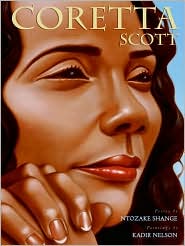
"Coretta Scott" by Ntozake Shange, Illustrated by Kadir Nelson

Image Courtesy of: http://img2.imagesbn.com/images/33250000/33257055.JPG
Bibliographic Citation
Title: Coretta Scott
Author: Ntozake Shange
Illustrator: Kadir Nelson
Year of Publication: 2009
Publisher City: New York
Publisher: Amistad
ISBN: 9780061253652
Illustrator Website: http://www.kadirnelson.com/
Media Used for Artwork: Oil paint

2009 Students’ List

Awards
·         School Library Journal Starred Review
·         Booklist Starred Review
·         Publishers Weekly Starred Review

Annotation
A biography picture book about Coretta Scott told through poetry.  But this story also tells the story of the Civil Rights Movement in which she was involved along with her husband Martin Luther King, Jr.

Personal Reaction
                A poem is used to convey part of Coretta Scott King’s life.  It is a unique way to tell a biography because facts can not be conveyed.  It is the emotions that Scott felt during her life that are felt.  Besides Scott’s life this picture book also conveys part of the Civil Rights Movement, such as the March on Washington.
                Nelson’s oil paintings are very detailed and add visuals to the poem by Shange.  This can aid readers in understanding what is being conveyed in the stanzas.  The detail in the eyes of characters makes it almost seem like a reader is looking at a picture.  There is a moment where Scott and her siblings are left by the white school bus and the reader can see the tears from the illustration.
                During Black History month, this book would be good as an introduction to the Civil Rights Movement.  Readers can understand the emotions that were behind people’s action in that time.  Then from there historical facts can be added for education.

Use of a Simile: Comparing the moon in a creative way beings the poem.
“some southern mornings
the moon
sits like an orange
sliver by the treetops”

Use of Repetition: In the illustrations repetition is seen a few times.  For example, the moon rising over blackened foliage is seen as are profiles of Scott and King where they were singing and praying.

Monday, June 20, 2011

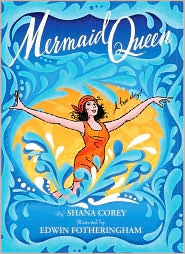
"Mermaid Queen: The Spectacular True Story Of Annette Kellerman, Who Swam Her Way To Fame, Fortune & Swimsuit History," by Shana Corey, Illustrated by Edwin Fotheringham

Image Courtesy of: http://img2.imagesbn.com/images/33600000/33604755.JPG
Bibliographic Citation
Title: Mermaid Queen: The Spectacular True Story Of Annette Kellerman, Who Swam Her Way To Fame, Fortune & Swimsuit History!
Author: Shana Corey
Illustrator: Edwin Fotheringham
Year of Publication: 2009
Publisher City: New York
Publisher: Scholastic Press
ISBN: 9780439698351
Author Website: No Author Website
Illustrator Website: http://www.edfotheringham.com/
Media Used for Artwork: Digital Media

Awards
·         Children’s Literature Association of Utah’s Beehive Book Award Nominee, Informational Books, 2011
·         Amelia Bloomer Booklist for Beginning Readers 2010
·         Booklist Top 10 Sports Books for Youth, 2009
·         Junior Library Guild Selection, 2009

Annotation
The biography of Annette Kellerman, famed for her swimming abilities and fashion sense when it came to swimsuits.  Kellerman was also a huge advocate of the “modern woman,” promoting athleticism and more social freedom for women.

Personal Reaction
First, this biography promotes the life of a strong female that has almost been forgotten about.  Girls can be inspired by the independent nature of Kellerman.  She was a rebel but rebelled over things that needed to be changed.  Because of her, female athletes became more accepted and bathing suits improved from the skin covering outfits women wore before.  Second, it helps to promote exercise and following interests.  The author does a wonderful job of showing Kellerman’s passion for swimming.  By showing what passion for something does for a person’s life, readers are able to see what success they could achieve as well. 
                Corey provides a nice overview of Kellerman’s life, while also providing sources for readers to use for further research.  The essay at the end reinforces what Corey conveys in the picture book about Kellerman’s amazing talent and wonderful personality.  It was interesting that select words in the text are bolded, putting emphasis on them.  This method was used for happy moments when Kellerman was swimming and also when others tried to put her down.  It shows a contrast between what others thought of the Mermaid Queen and what she thought of her life.
                The illustrations dominate the pages, making the text like a narrator’s voice-over for a movie.  Because of the importance of water to Kellerman’s life, it is seen in most images, including Kellerman’s own clothing.  While Kellerman looks realistic, others are cartoon like.  This puts the emphasis on the main character.
                This biography is a good addition to any summer program that is promoting activities during the hot days.  It also brings inspiration by telling the story of a young girl who overcame many things to achieve her goals and better the world.

"Surfer of the Century: The Life of Duke Kahanamoku" by Ellie Crowe, Illustrated by Richard Waldrep

Image Courtesy of: http://ecx.images-amazon.com/images/I/51fyI7l3fHL._SL500_AA300_.jpg
Bibliographic Citation
Title: Surfer of the Century: The Life of Duke Kahanamoku
Author: Ellie Crowe
Illustrator: Richard Waldrep
Year of Publication: 2007
Publisher City: New York
Publisher: Lee & Low Books Inc.
ISBN: 9781584302766
Illustrator Website: No Illustrator Website
Media Used for Artwork: Color Pencil, Gouache

Awards
·         Asian Pacific American Award for Literature, Picture Book Winner, 2007-2008
·         Texas Bluebonnet Award, 2010-2011
·         Bank Street College Children’s Book Committee’s Children’s Books of the Year,

Annotation
A biography of Duke Kahanamoku, the father of modern surfing, during his early career as a member of the United States Olympic team for swimming and the many challenges he had to deal with, including racism and financial difficultly. 

Personal Reaction
                This book will be a draw to any older reader who enjoys surfing or swimming.  The biography of Duke Kahanamoku is done expertly in this picture book.  It is apparent that Crowe did a great deal of research to make sure that her facts were accurate about the life of the man who is the father of modern surfing. 
The picture book focuses mostly on his early career as a member of the Olympic swim team but besides stating the facts of his life, Crowe manages to bring up the racism that Kahanamoku had to endure in a subtle way so that it did not take over the entire story.  As a group, readers can discuss how issues of racism affected everyone in the past, even those who were famous.  This picture book can also be used with a group of other biographies of famous figures who succeeded despite the racial issues they had to endure.
Waldrep did an amazing job with the illustrations.  They are reminiscent of retro travel posters that were used in the era Kahanamoku lived.  The art deco style is very geometric, but the use of light colors used to represent Hawai’i softens the illustrations.   Some of the images even felt like postcards that anyone could send to family on their trip to Hawai’i.  One of my favorite images is one that occurs in the story where Kahanamoku introduced his style of surfing to Australians.  He holds a girl on top of his shoulders as they surf the waves.  Even though it is a still image, I can still feel the movement of the waves and the wind.
The style used in the illustrations is unique from other picture books I have seen.  Not only did Waldrep use a style of art that was popular in the era Kahanamoku was alive, it is also a style that is not seen often in current works.  But the beauty of the art deco style is wonderful and should not be forgotten.  This book is a good way to introduce it to readers.

Use of Onomatopoeia: To add to the tension of the story the author added onomatopoeia so that readers would feel they were at the race being described.
Example:
“BAM!  The pistol shot rang out.”

Use of Simile: One of the most adorable uses of a simile I have seen in a long time.  Comparing Kahanamoku to a tadpole when he first was taught to swim not only shows his age but also reminds the reader of the water.
Example:
“Wiggling like a little tadpole, Duke made his way back to the canoe.”

Saturday, June 18, 2011

"A River of Words" by Jen Bryant, Illustrated by Melissa Sweet

Image Courtesy of: http://www.inspire4less.com/productimages/9780802853028.JPG.
Bibliographic Citation
Title: A River of Words: The Story of William Carlos Williams
Author: Jen Bryant
Illustrator: Melissa Sweet
Year of Publication: 2008
Publisher City: Grand Rapids
Publisher: Eerdmans Books for Young Readers
ISBN: 978-0-8028-5302-8
Illustrator Website: http://melissasweet.net/
Media Used for Artwork: Watercolor, Collage

2009 Students’ List

Awards
·         Caldecott Honor Book 2009
·         School Library Journal Best Books 2008
·         New York Times Book Review Best Illustrated Children's Books of 2008
·         National Council of Teachers of English’s Orbis Pictus Award 2009
·         Cooperative Children's Book Center Charlotte Zolotow Honor Award 2009

Annotation
The biography of doctor and poet, William Carlos Williams, told through a mixture of his poetry and scrapbook illustrations.  Even as Williams grows up and gets a professional job, he still returns to the poetry he loves.

Personal Reaction
                Biography picture books are becoming one of my new favorites when it comes to illustrated books.  These types of books convey information about a person’s life but also keep it entertaining.  Facts are not just stated, a story is developed.  Readers are allowed to see a brief glimpse of a life without becoming overwhelmed by dates and places.  That information was saved until the end of the book and recommendations of future reading was also provided.
                Because this story was about a poet it was nice to be given examples of his work.  The poetry was well weaved into the narration.  Bryant worked to make her writing work with Williams’ poetry so that a reader is not charred by the changes in styles.
                The illustrations in this book are so unique, not something that is normally seen in picture books.  It is as if the reader is looking through a scrapbook that Williams could have made himself.  The mix of collage and hand written stanzas makes the poems more intimate.
                Both author and illustrator wanted Williams’ work to be the focus, not themselves or their styles.  If a reader did not know any better they could believe that this book was written and narrated by Williams, himself.
                Poetry can be a difficult subject for older readers to understand, especially when they are first beginning to learn to analyze it.  This narrative teaches readers how to analyze the work of a particular poet, by telling about the poet’s inspiration and giving examples of his work.  But it still allows room for the reader to make their own judgment.  If only all poetry could be taught in this way, especially for early poetry enthusiasts.
               
Use of Metaphor: The poetry of William Carlos Williams, which is featured in this book, provides a few examples of metaphor usage.
Example:
“There is a bird in the poplars!
It is the sun!”

Use of Simile: Bryant has poetic moments in her biography of Williams that uses similes to describe him and his poetry.
“Like the water that sometimes ran slow, smooth, and steady, and other times came rushing in a hurried flood, Willie’s lines flowed across the page.”

Thursday, June 9, 2011

"The Wall: Growing up behind the Iron Curtain" by Peter Sis

Image Courtesy of: http://media.us.macmillan.com/jackets/500H/9780374347017.jpg

Bibliographic Citation
Title: The Wall
Subtitle: Growing up behind the Iron Curtain
Author/Illustrator: Peter Sis
Year of Publication: 2007
Publisher City: New York
Publisher: Frances Foster Books
ISBN-13: 978-0-374-34701-7
Author/Illustrator Website: http://www.petersis.com/index2.html
Media Used for Artwork: Marker, Crayon

2009 Students’ List

Awards
·         American Library Association Best Books for Young Adults
·         New York Times Book Review Best Illustrated Books of the Year
·         Parents' Choice Award Winner
·         Publishers Weekly Best Children's Books of the Year
·         School Library Journal Best Books of the Year

Annotation
This is the autobiography of Peter Sis, the author/illustrator.  It specifically emphasizes on his life growing up in Czechoslovakia during the Cold War with strong emphasis on the images to tell the story. 

Personal Reaction
The bulk of “The Wall: Growing Up Behind the Iron Curtain” is the drawings by Peter Sis, with the addition of personal journal entries.  The reader is bombarded by the images of Sis’s childhood, with only a few words telling the story.  But as the reader looks at the images individually it becomes clear that the story is being told through them.  Whoever decides to read this book should do so several times so that the many levels can be appreciated individually.
The most important level of the book is the pictures.  The images show action and convey emotion.  Most of the drawings are black and white with touches of color. At the beginning of the story red in the dominate color added to the black and white images.  The addition of the red is an allusion the color worn by Communists during the Cold War era.  As the narrator becomes aware of the many wrongs that himself and his people have endured with living behind the Iron Curtain the images begin to change.  The narrator finds hope through his drawings and as he matures more color is added, not just the red that dominated the pictures at the beginning of the book.  At one point the main character of the story uses the colors that he surrounds himself with as wings to escape the life he had lived.  One of my favorite examples of the use of color in the pictures is when the narrator and his friends constantly repaint the wall near the end of the book.  Each time bright color is used and the blank canvas allows new art to be introduced.  The painters continue to have dreams and continue to find new ways to show it on the wall.
It is clear from the beginning that Sis wants to convey his childhood in Czechoslovakia.  Besides the pictures that visually show his life there are the few words that are used.  Historical facts are mentioned briefly, because though they are important it is not as important as Sis’s story.  The journal entries that separate the sections of the book are meant to prepare a mature reader for the story that will be conveyed through the pictures.  It also shows how the narrator’s view of his world changes as he ages.
The journal entries and the images work together in this book to convey the story of the narrator’s childhood.  One cannot stand alone from the other.  The pictures show the narrator’s life and the journal entries and historical facts provided settles the story in a specific environment.  The reader never forgets that this story is about life behind the Iron Curtain.
Older readers can relate to this picture book for the fact that as they grow up their perception of the world changes.  Things that were thought of as good as a child are often times seen as bad as an adult. 
Besides the reader being able to relate to the narrator, this book will be a good addition to classroom.  In California, tenth graders are taught about the effects of post-World War II in their World History classes. This picture book can provide a personal account of what students are taught during this part of the semester.  Sis mentions historical dates, which students will also be learning about.  By understanding what life was like for a child in this era, high school students can come to understand the importance of the dates and facts being taught to them.  Sis’s biography makes what occurred real, not just facts listed in a textbook to be remembered for a test.