Showing posts with label repetition. Show all posts

Sunday, July 10, 2011

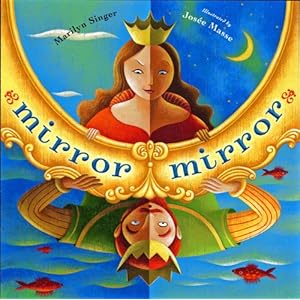
"Mirror Mirror: A Book of Reversible Verse" by Marilyn Singer, Illustrated by Josee Masse

Image Courtesy of: http://ecx.images-amazon.com/images/I/61v-WHRXuSL._SL500_AA300_.jpg
Bibliographic Citation
Title: Mirror Mirror: A Book of Reversible Verse
Author: Marilyn Singer
Illustrator: Josee Masse
Year of Publication: 2010
Publisher City: New York
Publisher: Dutton Children’s Books
ISBN: 9780525479017
Author Website: www.marilynsinger.net
Illustrator Website: www.joseemasse.com
Media Used for Artwork: Acrylic Paint

Copyright 2010/2011

My Top 10 Favorite Picturebooks for Older Readers

Awards
·         American Library Association’s Notable Children’s Book, 2011
·         Cybil Award in Poetry
·         New York Public Library Best 100 Children’s Books, 2010
·         Publishers Weekly’s Best Children’s Books of 2010
·         Washington Post’s Top 15 Children’s Books of 2010

Annotation
We are always taught that there are two sides to a story.  This picture book is a series of poems that brings to light the different perspectives from famous fairy tales that any reader will know and enjoy.

Personal Reaction
                The style of poems, referred to as reverso poems by Singer, are very amusing.  Retelling classic tales are always entertaining to read.  It is a great way to show how there are always several points of views in any story.  The fact that the poems are based off well known fairy tales allows readers to see the famous characters in a new life.  My favorite poem duo in the book is “Longing for Beauty,” which tells the story of “Beauty and the Beast” from both the Beast’s and Beauty’s perspective.  Rewriting popular stories from another perspective is very trendy.  Take for example, “Wicked” by Gregory Maguire, which is written from the Wicked Witches point of view.  In fact, anything written by Maguire is a good example of this.  So Singer’s book can be a good starting off point to introduced older readers to these types of stories.
                The illustrations also take on the reverso quality of the poems.  Each drawing is split down the middle showing scenes from every fairy tale from different points of views.  Yet they are also connected together showing that they are the same story.  Take for example, the illustration from “Mirror Mirror.”  On one side Snow White is taking care of the dwarves in the forest and the other the Evil Queen prepares the take her revenge.  What connects these different pictures together is how the trees on Snow White’s illustration lines up with the old woman persona that the Evil Queen takes on, on the other side.

Use of Repetition:  Each poem is the same poem that is first told from top to bottom, then flipped and retold from bottom to top.
Example: “Longing for Beauty”
1st Poem                                              2nd Poem
A beast                                                 Longing
can love                                               stirs
beauty.                                                 a soft heart.
A moist muzzle                                     Look
can welcome                                        beneath fur.
a rose.                                                 A nightingale singing,
A hairy ear                                          can prize
can prize                                              a hairy ear.
a nightingale, singing.                            A rose
Beneath fur,                                         can welcome
look!                                                   a moist muzzle.
A soft heart                                         Beauty
stirs,                                                    can love
longing.                                               a Beast.

Curriculum: Grade 6- English: As stated by Singer in the back of the book, people should try writing a reverso poem.  This can be a good challenge for students to figure out how to write in two points of view using the same words.  It will require them to develop their vocabulary as well as their writing skills.

Friday, June 24, 2011

"Goal!" by Mina Javaherbin, Illustrated by A.G. Ford

Image Courtesy of: http://minajavaherbin.com/blog/wp-content/uploads/2009/11/goal_lg-258x300.jpg
Bibliographic Citation
Title: Goal!
Author: Mina Javaherbin
Illustrator: A.G. Ford
Year of Publication: 2010
Publisher City: Somerville
Publisher: Candlewick Press
ISBN: 9780763675717
Media Used for Artwork: Oil Paint

Copyright 2010/2011

Awards
·         International Reading Association’s Notable Book for a Global Society List, 2011
·         Bank Street Library Irma Black Award Semi-Finalist 2010-2011
·         California Young Reader Nominee, 2011-2012
·         Texas Library Association’s Bluebonnet Award Master List 2011-2012
·         Smithsonian’s Notable Books for Children, 2010

Annotation
In South Africa a boy has received a regulation soccer ball for being the best reader in class and wants to share the prize with his friends. They bond over the game, even with the threat of bullies.

Personal Reaction
                This is a good story that shows the importance of friendship.  The boys in the story bond over the game of soccer.  They even work together to fend off the bullies that want to steal their new regulation soccer ball.
                Older readers will enjoy this book for its subtleness.  Though it is never directly stated it is clear through the illustrations that the characters in the story must endure a great deal of poverty.  The boys’ clothes are a little more worn, with stains and tears.  The buildings are also shabby.  But things like that are ignored in the text because the focus is on the joy of playing soccer.  And above all the gift of a new soccer ball is all the more important.
                This picture book would be good to show the universal nature of children, even when they live in a range of environments (location, financial, etc.).    Things like a game of soccer in the middle of the street is something every child could relate to.  This book teaches that every child is the same, no matter what his or her circumstances are.

Use of Metaphor:
“When we play,
the sound
of our kicks
on the ball
is music.”

Use of Onomatopoeia:
“I steal from Hassan
and whoosh like the wind,
glued to the ball.”

Use of Repetition:
“Left is clear.
Right is clear.”


Tuesday, June 21, 2011

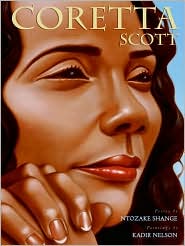
"Coretta Scott" by Ntozake Shange, Illustrated by Kadir Nelson

Image Courtesy of: http://img2.imagesbn.com/images/33250000/33257055.JPG
Bibliographic Citation
Title: Coretta Scott
Author: Ntozake Shange
Illustrator: Kadir Nelson
Year of Publication: 2009
Publisher City: New York
Publisher: Amistad
ISBN: 9780061253652
Illustrator Website: http://www.kadirnelson.com/
Media Used for Artwork: Oil paint

2009 Students’ List

Awards
·         School Library Journal Starred Review
·         Booklist Starred Review
·         Publishers Weekly Starred Review

Annotation
A biography picture book about Coretta Scott told through poetry.  But this story also tells the story of the Civil Rights Movement in which she was involved along with her husband Martin Luther King, Jr.

Personal Reaction
                A poem is used to convey part of Coretta Scott King’s life.  It is a unique way to tell a biography because facts can not be conveyed.  It is the emotions that Scott felt during her life that are felt.  Besides Scott’s life this picture book also conveys part of the Civil Rights Movement, such as the March on Washington.
                Nelson’s oil paintings are very detailed and add visuals to the poem by Shange.  This can aid readers in understanding what is being conveyed in the stanzas.  The detail in the eyes of characters makes it almost seem like a reader is looking at a picture.  There is a moment where Scott and her siblings are left by the white school bus and the reader can see the tears from the illustration.
                During Black History month, this book would be good as an introduction to the Civil Rights Movement.  Readers can understand the emotions that were behind people’s action in that time.  Then from there historical facts can be added for education.

Use of a Simile: Comparing the moon in a creative way beings the poem.
“some southern mornings
the moon
sits like an orange
sliver by the treetops”

Use of Repetition: In the illustrations repetition is seen a few times.  For example, the moon rising over blackened foliage is seen as are profiles of Scott and King where they were singing and praying.

Monday, June 13, 2011

"The Moon over Star" by Dianna Hutts Aston, Illustrated by Jerry Pinkney

Image Courtesy of: http://www.ala.org/ala/mgrps/rts/emiert/cskbookawards/img/2009/the_moon_over_star.jpg
Bibliographic Citation
Title: The Moon over Star
Author: Dianna Hutts Aston
Illustrator: Jerry Pinkney
Year of Publication: 2008
Publisher City: New York
Publisher: Dial Books for Young Readers
ISBN: 978-0-8037-3107-3
Author Website: No Author Website
Media Used for Artwork: Watercolor

2009 Students’ List

Awards
·         American Library Association’s Coretta Scott King Illustrator Honor Award, 2009

Annotation
The story of a young narrator on the day that mankind first landed on the moon in 1969.  But the story is also about the narrator realizing more about her grandfather and his life.

Personal Reaction
                While this story is about a family in a town called Star watching the moon landing in 1969, there is another story going on as well, the story of Mae and her grandfather.  The family watches in amazement as the world changes by a group of men going to space, except for one member, Mae’s grandfather.  It is told how he thinks the space program is a waste of money.  As the story continues Mae begins to see how hard her grandfather has worked and where his views come from, and yet she still is fascinated and excited by the spacewalk.  One of the sweetest moments of the book is at the end when the grandfather tells his granddaughter to keep dreaming but to always remember the importance of home.
                On one level this book is about the moon landing, but on another it focuses on the people who were observing the event from a distance.  Readers can relate to the characters of Mae and her siblings because they have also been in the same position when dynamic things have occurred in the world that they were not directly involved in but where part of it none the less.  Some examples of this in recent history include: the events on 9/11, the death of Osama bin Laden, the tsunamis, the earthquakes in New Zealand and Japan, and so on.  Though they were not directly involved they still remember the news reports, such as Mae remembered Walker Cronkite saying “Man on the moon!” on the television.
                The watercolors in this book are beautiful.  The detail allows readers to actually see the age of the Grandfather that the narrator describes as well as the details of the families household and even the astronauts’ footprints on the Moon.
What is also interesting is the variety of images in the book.  The illustrations work with the narrative to visually tell the two stories that are going on: the walk on the Moon and Mae’s interaction with her grandfather.  With just a flip of the page a reader is brought to outer space then back to the family in the town of Star.  The visuals help to transition the reader back and forth between settings without jarring them by the suddenness.
One of the most powerful images is a double page picture of a rocket launching, which the children imagine while pretending to be astronauts in their front yard.  The reader is struck by the iconic nature of the image.  It is easy to understand how the children remember the many details of a rocket launch since they are currently living it and are bombarded by those detailed on television.

Use of Symbol: Star in this part of the novel is a symbol for Mae’s family and home.
Example: “Keep on dreaming, Mae,” he said.  “Just remember,
We’re here now together
On the prettiest star in the heavens.”

Use of Repetition: The story is divided into different sections and to indicate the beginning of a new section it starts with “Once upon a summer’s…”  It is the last word only that changes, showing the passage of time.

Sunday, June 12, 2011

"The Composer is Dead" by Lemony Snicket, Illustrated by Carson Ellis

Image Courtesy of: http://www.artscriticatl.com/img/6a011570777493970b0115707e2ab6970c-800wi.jpg
Bibliographic Citation
Title: The Composer is Dead
Author: Lemony Snicket
Illustrator: Carson Ellis
Year of Publication: 2009
Publisher City: New York
Publisher: HarperCollins Publishers
ISBN: 978-0-06-123628-0
Illustrator Website: http://www.carsonellis.com/
Media Used for Artwork: Watercolor, Ink

2009 Students’ List

Awards
·         Time Magazine’s Top Ten Children’s Books of 2009

Annotation
The Inspector tries to solve the case of the murdered Composer by questioning the members of the Orchestra.  All of them are under suspicion but all have an alibi.  So then the question remains, who killed the Composer?

Personal Reaction
                This is such an amusing book that teaches readers about an orchestra and does so in a very creative way, as a murder mystery.  It allows questions to be asked, by the narrator, in this case the Inspector, so that a reader can learn about an orchestra without it becoming a boring lecture.  The author teaches readers about each section of the orchestra and uses advance vocabulary but does so without talking down to the reader.  Snicket’s respect of his readers and their intelligence can allow for a reluctant reader to feel empowered and continue to find other books to read.
                The illustrations are minimalist, usually having just one picture on a page: a fly, a bust, the Inspector, and so on.  The minimalism is continued in the actually drawings.  An example of this is the silhouette’s used when each part of an orchestra is introduced.  This allowed for a visual hint to readers that about with set of instruments was being taught.  The times that the pictures become more elaborate are when the instruments begin to play; scenes are created with music notes dancing through the scene.
A unique feature of this particular book is the accompanying CD which allows for a chance to listen to the story being narrated (by Lemony Snicket aka Daniel Handler) as well as listen to an orchestra perform (composed by Nathaniel Stookey and performed by the San Francisco Symphony).  This allows an opportunity for students to understand the impact of music on narration, adding a depth to the story.  The appreciation of music that is taught in this book and CD is desperately needed in schools now, especially with the continued loss of classes about the arts.

Curriculum: Grade 5- This book and its accompany CD can be used in the teaching about music.  Not only does the book allow children to understand the different sections of an orchestra and the dynamics.  The addition of the CD allows students to listen to the instruments they just learned about. At one point of the book a list of several famous composers is made, which can be a start off point to introduce these famous composers and their works.

Use of simile: When the Inspector talks to the Flutes, they compare to themselves to birds. 
Example: “AHA! the Inspector cried.  “Perhaps you murdered the Composer for making you act like birds!”

Use of repetition: Very early on in the book the Inspector declares how he will find the enemies of the dead composer somewhere in the orchestra, but does this by repeating the beginning of the line but changing the ending.
Example: “I will find them if they are lurking in the strings.  I will find them if they are lurking in the brass.  I will find them if they are lurking in the woodwinds.  I will find them if they are lurking in the percussion section.”

Use of Personification: When the Inspector talks to each section of the orchestra there is no description of individuals (in the text or illustrations), it is as if the instruments themselves are speaking.  This is also done through the illustrations when each section of the orchestra is introduced.  Instead of groups of people it is images of the instruments.
Example: “The Violins answered first, of course.”

Use of Onomatopoeia: The most dominate example of this in the book is when the Inspector repeatedly says “AHA!” after each group of instruments have spoken.

Use of sophisticated language: The use of specific instrumental names will help readers learn about orchestras.  And something amusing that the author does when using difficult words is define it in a unique way.
Example: “Last night was incredibly important for us,” proclaimed the Trumpets in a boisterous manner, a phrase which here means “loudly and with a certain arrogant rudeness.”

"Cinderella Skeleton" by Robert D. San Souci, Illustrated by David Catrow

Image Courtesy of: http://mediamacaroni.com/wp-content/uploads/2009/10/cinderellaskeleton.jpg
Bibliographic Citation
Title: Cinderella Skeleton
Author: Robert D. San Souci
Illustrator: David Catrow
Year of Publication: 2000
Publisher City: New York
Publisher: Silver Whistle
ISBN: 0-15-202003-9
Illustrator Website: http://www.catrow.com/
   A video of Catrow drawing Cinderella Skeleton: http://vimeo.com/6650302
Media Used for Artwork: Pencil, Watercolor

My Top 10 Favorite Picturebooks for Older Readers

Awards
·         International Reading Association Children's Choices, 2001

Annotation
This picture book is a retelling of the fairytale Cinderella with a few unique twists that morph the world many are use to.  Cinderella is no long a beautiful living girl but instead a decaying skeleton.

Personal Reaction
                This isn’t the Disney version of Cinderella that people are use to; it is a reinvention of the story that is far closer to the darker, bloodier version by the Brothers Grimm.  No toes or heels are cut off in “Cinderella Skeleton” but foot bones are snapped off with ease.
                The story of “Cinderella Skeleton” is told as a poem.  Robert D San Souci used the rhythm scheme he created to his full advantage, while not taking away from the telling of the story.  The author must have been aware that his choice to make Cinderella a corpse could become quickly dark and choose to use humor to lighten the mood.  An example of this is that house in which Cinderella Skeleton resides “invites guests to REST IN PEACE.”
“Cinderella Skelton” will attract older readers who aren’t drawn to happily ever after Disney versions of fairy tales any more but still like fairy tales.  After reading this retelling, a reader can start searching out retellings of fairytales that are novel length, such as “Beastly” by Alex Flinn (or even watching the movie adaption).  The story of Cinderella is the one that readers know by heart but the reinvention of the characters and setting allows reader to see the story from another perspective.  It is also a way to teach that certain basic stories are constantly used throughout literature but are morphed to fit an author’s ideas or illustrator’s design.
The artwork is what drew me to this book in the first place.  Cinderella in this case is a skeleton with “teeth like polished kidney stones” and “dankish hair” that Prince Charnel (a very creative renaming of Prince Charming) adores.  One almost feels that David Catrow was inspired by Tim Burton films.  There are touches of Jack Skellington from “The Nightmare Before Christmas” and the bride from “Corpse Bride” in the illustrations.  Catrow illustrated the skeletons so that they would have such expressions and personalities.  And Cinderella Skeleton’s silk gown of spider web has a frightening elegance to it.  Beauty presented in an unexpected way.  Though the skeletons could be seen as frightening to some, others will be delighted in the humor Catrow also uses in his drawings.  For example: the carriage that takes her to the Halloween Ball is a funeral wagon, and instead of a mighty steed Prince Charnel rides a bicycle to search for his lost love.  Overall, this is a delightfully morbid retelling of a classic fairytale that is enhanced by the illustrations.

Use of Rhyme: Each stanza is broken up the same wait.  The first line always begins “Cinderella Skeleton,” and the rhythm scheme after is ABBCCA throughout.

Use of Alliteration: Throughout the poem repetition of the first letter of the word is used.  Some examples include:
Decayed, decrepit-what a fright.”
“And firmly packed with spite and spleen.”

Use of Onomatopoeia: Making a word from a sound is used a few times in this picture book.  Some examples include:
“Saw witch touch wand- Tip-tap!-to all.”
“Ignoring the thump of her footless stump.”

Use of Repetition: Throughout the story each stanza starts with Cinderella Skeleton.