Showing posts with label sophisticated language. Show all posts

Thursday, July 7, 2011

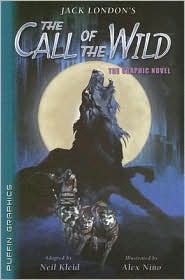
"Jack London's The Call of the Wild: The Graphic Novel" by Neil Kleid


Image Courtesy of: http://img2.imagesbn.com/images/17930000/17931974.JPG
Bibliographic Citation
Title: Jack London’s The Call of the Wild: The Graphic Novel
Author: Neil Kleid
Illustrator: Alex Nino
Year of Publication: 2006
Publisher City: New York
Publisher: Puffin Books
ISBN: 014240571X
Illustrator Website: No illustrator website
Media Used for Artwork: Pen and pencil sketches on a white background. 

Fiction Graphic Novel

"The Classics Revisited" Group Project-  Please visit our presentation here to learn more about how this graphic novel and others can be used in a high school curriculum.

Annotation
Follow Buck, in this graphic novel, as he is taken from his home and into the wild frozen Yukon. Taught the law of club and fang, Buck becomes a superior sled dog until abandoning civilization and joining a wolf pack.

Personal Reaction
(Provided by J.Medina)
                I loved this book as a teenager and it was really refreshing to reread it in a graphic novel format.  The illustrator, Alex Nino, captured the movement and body language of the dogs in the story perfectly.  The body language of the dogs also helps the reader to understand the dogs moods and feelings.  The sketches are mostly outlines and facial expressions, light on details and scenery (which given the frozen white setting is appropriate).  Kleid adapted the story well, managing to keep all of the main storyline (that I could remember) from the original story in the graphic novel.  I can only imagine how much of a challenge it is to take a full length novel and shorten it to a cohesive graphic novel format.  Some movies I know can't even accomplish that, and they have a lot more to work with.  This graphic novel does successfully tell the story on its own alone but could also be used as a supplement to the original novel to further aide the reader's understanding.   

Use of Sophisticated Language: (1) "Cunning, intelligent; virile and dangerous, he had become a thing of the wild." (2) "Buck watched with apprehension as they haphazardly loaded the sled."

Use of Simile: "And truly Buck was the fiend incarnate, raging at their heels and dragging them down like deer."

Use of Metaphor:  "And truly Buck was the fiend incarnate, raging at their heels and dragging them down like deer."

Curricular Connection: 9th to 12th Grade Classic Literature
California Reading Standards for Literature for grades 6 to 12: Craft and structure - Determine the meaning of words and phrases as they are used in the text, including figurative and connotative meanings; [for example the phrase "the law of club and fang"].

Wednesday, June 29, 2011

"The Yankee at the Seder" by Elka Weber, Illustrated by Adam Gustavson


Image Courtesy of: http://www.kveller.com/images/Article_images/yankee-at-the-seder.jpg
Bibliographic Citation
Title: The Yankee at the Seder
Author: Elka Weber
Illustrator: Adam Gustavson
Year of Publication: 2009
Publisher City: Berkeley
Publisher: Tricycle Press
ISBN: 9781582462561
Illustrator Website: http://www.adamgustavson.com/
Media Used for Artwork: Watercolor, Gouache

Awards
·         Publishers Weekly Starred Review
·         NCSS/CBC Notable Children’s Trade Books in the Field of Social Studies
·         Bulletin Blue Ribbon Book
·         Association of Jewish Libraries Sydney Taylor Book Award, 2010

Annotation
The Civil War has ended and Passover is about to begin.  Jacob is resentful of the North.  But when an unexpected guest, a Jewish Yankee, comes to Passover everyone at the dinner must rethink how they observe past enemies.

Personal Reaction
                This picturebook provides readers with a good example of how views vary around the world, even among people of the same religion/political view/etc.  Readers can use this book as a starting off point to discuss how differing cultures can still unite among some commonalities.  Also, this story teaches readers about the Jewish religion, also expanding their understanding of other cultures.  The fact that this story is based on an actual event is quite interesting and makes the story all the more impactful.  “The Real Story” at the end of the book shows the amount of research conducted by Weber.  It was nice to even see actual photographs of Corporal Levy’s saber that was such an important part of the story.
                The illustrations do a wonderful job of conveying the emotions of the characters that are being described in the text.  One of my favorite illustrations is of Levy, Jacob’s father and grandfather’s boots, showing their desire to not start a confrontation if they discussed the war.  I agree with the narrator when he stated “So it was something to see as they all tried to make polite conversation without talking about the one subject that was most on their minds,” especially because of the illustration.

Use of sophisticated language: The author provides definitions of terms used for Passover at the beginning of the book.

Use of personification:
Example: “If a stray crumb did somehow find its way into our house, it would just die of loneliness.”

Thursday, June 23, 2011

"Persepolis: The Story of a Childhood" by Marjane Satrapi


Image Courtesy of: http://www.randomhouse.com/pantheon/graphicnovels/art/persepolis_cover_big.jpg
Bibliographic Citation
Title: Persepolis: The Story of a Childhood
Author/Illustrator: Marjane Satrapi
Year of Publication: 2003
Publisher City: New York
Publisher: Pantheon
ISBN: 0375422307
Author/Illustrator Website: No Author/Illustrator Website
Media Used for Artwork: Ink

2009 Students’ List

Nonfiction Graphic Novel

My Top 10 Favorite Picturebooks for Older Readers

Awards
·         Fernando Buesa Peace Prize, 2003
·         New York Times Notable Book
·         Time Magazine “Best Comic of the Year,” 2003
·         Young Adult Library Services Association’s Alex Award, 2004

Annotation
This graphic novel tells the story of Marjane Satrapi as she grew up in Iran during the Islamic Revolution, a very turbulent time where her life was in constant change.

Personal Reaction
                What is happening in the Middle East is a huge concern for many people.  Yet in each country we are only given one side of the story.  The graphic novel autobiography from Marjane Satrapi provides another perspective that most American’s do not think about, someone from Iran.  Satrapi’s story attempts to show readers that not every person in Iran is an extremist, like the ones seen on the nightly news.  This is a good story to help keep people open-minded in a time when it is so easy to let biases and stereotypes dictate lives.
                The series of little vignettes is an interesting tool to deliver the story of the child’s life in the novel.  It works well because several different stories are told that interweave together, also it emulates a child’s mind that is always thinking of new things and topics.
                The illustrations are childlike as well, which also helps convey to readers that they are reading a story that is suppose to be from a child’s perspective.  Often times the figures and scenery are very simple, which puts emphasis on the words.  The use of black and white is very powerful, especially in moments where repetition of figures is used.  For example, in the section entitled “The Key,” the illustration of the girls beating their breasts is all the more powerful because it is in black and white.  There is no way to tell the girls apart, showing that they are all forced to deal with the circumstances of their lives.

Curriculum: Grade 10- According to California State Board of Education, students in 10th grade history are to learn about “the challenges in the regions, including their geopolitical, cultural, military, and economic significance and the international relationships in which they are involved.”  The Middle East is one of these locations. 
This graphic novel would be a good addition to this part of the curriculum because it teaches about the history of a region from the perspective of someone who lived through it.  All material is biased to some degree, but by providing multiple perspectives students are able to form a better understanding of controversial topics.

Use of Allusion: When the family goes on a vacation the family is seen on a flying carpet, reminiscent of “Arabian Nights.”

Use of Simile: The children often use similes in an attempt to understand the choices made my the government and adults.
“The revolution is like a bicycle.  When the wheels don’t turn, it falls.”

Use of Sophisticated Language: The narrator uses a variety of words that can be difficult to understand.  Many are military or political terms.
“The truth is that 50 years ago the father of the Shah, who was a soldier, organized a putsch to overthrow the emperor and install a republic.”

Monday, June 13, 2011

"John, Paul, George & Ben" by Lane Smith

Image Courtesy of: http://www.designmom.com/wp-content/uploads/2007/06/johnpaul.jpg
Bibliographic Citation
Title: John, Paul, George & Ben
Author/Illustrator: Lane Smith
Year of Publication: 2006
Publisher City: New York
Publisher: Hyperion Books for Children
ISBN: 078684893-6
Author/Illustrator Website: http://www.lanesmithbooks.com
Media Used for Artwork: Ink, Oil Paint, Parchment Paper

Awards
·         California Young Reader Medal, Winner for Picture Books for Older Readers, 2011
·         Publisher’s Weekly Best Book of the Year
·         School Library Journal Best Books of 2006
·         New York Times Best Illustrated Book of the Year
·         Parenting Magazine Best Book of the Year

Annotation
                The story of five historical figures of early American history and how certain characteristics each figure possessed helped made them important during the Revolutionary War in the soon to be United States.

Personal Reaction
                A very cute little story that uses commonly known antidotes about the founding fathers of the United States: John Hancock’s famous signature, George Washington chopping down the cherry tree, etc.  This picture book is a good way of introducing older readers to early American history, as well as teaches them how certain characteristics can help to develop a person into what we perceive as a good person and for that matter a hero.
                After learning about the historical figures, Smith then provides a page telling what was false and true in the story.  This is a useful tool in not only teaching historical facts but also showing how authors can develop a fictitious world while still using accurate facts.
                The illustrations used in this book as very unique.  Smith made the pictures looked aged, as if they were drawn during the era that the men being discussed lived.  This provides a visual hint to readers that the story is being told in a different era, the addition of using “ye olde” in the text helped as well.

Curriculum: Grade 5- This book can be used as an introduction to the Founding Fathers of America.   Students learn about the antidotes that each man is famous for and learn a brief history of their involvement in the American Revolution.  After reading this book, students can do individual research on the five men discussed in the book and do presentations for the class.

Use of Simile: Paul Revere speaking loudly could have been explain in a number of ways, but by using a simile readers understand the effect his voice has on the rest of the characters in the story.
Example: “Paul was like a bullhorn in a china shop.”

Use of Onomatopoeia: Paul Revere’s section of the book was very loud, so of course the noises would become words.
Example: “All day his head was filled with loud bings and bongs.”

Use of Sophisticated Language: The use of sophisticated language occurs the most in independent Thomas Jefferson’s section of the book.
Example: “Fear not, sir, I’ve used small words for the benefit of the dullards.”